Category: Uncategorized

  • Blendagogy: Now available!

    I’m pleased to annouce the release of the book Blendagogy: The art and science of blended learning design following this morning’s keynote at the FLANZ conference, held at Otago Polytechnic in Dunedin, New Zealand.

    The Blendagogy Famework struck a note; the four objectives, six factors, and three levels provide a comprehensive model for designing blended learning models ensuring coherence and strategic alignment.

    The book is now available as a free PDF and in print from Amazon; go to Blendagogy.org for details.
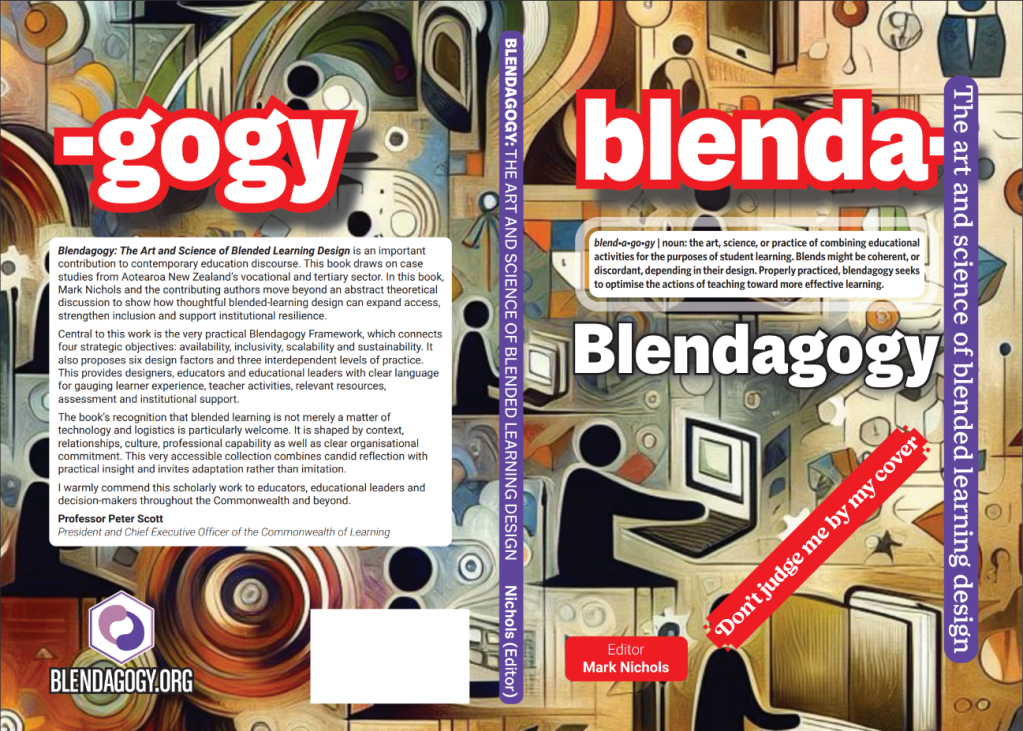
    The book has a forward by Professor Norm Vaughan, co-author of the excellent Teaching in blended learning environments and Principles of blended learning, and an endorsement by Professor Peter Scott, President and Chief Executive of the Commonwealth of Learning.

    Blendagogy is a strategic book, based on practice, aimed at decision-makers. Its 14 case studies provide a rich picture of possibilties in pactice, and validate the Blendagogy Framework – a rich foundation for embedding educaitonal practice.

    The website Blendagogy.org will continue to extend the Famework and bring together further reflections, case studies, and guidance for blended learning designers.

    Want to keep up to date, submit a blog post or case study, or otherwise participate in the blendagogy conversation? Drop Mark a line at info@blendagogy.org.


  • The Frankencourse

    Blended learning often brings together a chaotic collection of classes, engagement, resources, activities, assessment, events, technologies, and support services. From a learner perspective, these can get quite overwhelming; from a teacher’s perspective, they can get extremely demanding; from an institutional perspective, it can be challenging.

    Introducing: the Frankencourse.

    Yes, yes, – it’s actually Frankenstein’s monster. And in the book he’s actually highly intelligent, just misunderstood. But the point here is, blended learning can often go this way: disjointed, unnatural, not pleasing to the eye. And, in existential crisis (as the monster was, in the book).

    Blendagogy is the solution.

    The Blendagogy Framework provides a means of describing a blended learning model using a proven framework – the six factors – in the context of an over-arching purpose – the four objectives. These are situated within the context of the three levels. The Blendagogy Framework enables you to reason with the monster, helping to better design blended models to be more coherent, enduring, and replicable. The Framework also gives pointers for institutions wanting to extend and support blended learning initiatives.

    It’s all so much better, by design.

    The Blendagogy: The art and science of blended learning design book contains 14 case studies from blended learning practitioners. No Frankencourses, but plenty of examples of design and description to help you to avoid them.

    PDF here.

  • What is Blendagogy?

    Blendagogy is

    …the art, science, or practice of combining educational activities for the purposes of student learning. Blends might be coherent, or discordant, depending on their design. Properly practiced, blendagogy seeks to optimise the actions of teaching toward more effective learning.

    The Blendagogy Framework is a design model for creating blended learning solutions.

    …blended models should optimise four strategic objectives, be built around six descriptive factors, and align across three levels of context.

    The book Blendagogy: The art and science of blended learning design explains this Framework and validates it through 14 case studies of blended vocational learning solutions.

    • The four strategic objectives are for blended learning models that improve the availability, inclusiveness, scalability, and sustainability of learning.
    • The six descriptive factors are the dynamics of what learners do; what teachers do; the resources associated with teaching and learning; assessment; timetabling; and learner success services. Together, these for the workings of the blended model.
    • Finally, the three levels of context are macro (that of the education system), meso (that of the institution or academic unit), and micro (the actual subject being taught). A blended learning model needs to make sense across all of these levels for it to be optimal.

    The Blendagogy Framework suggests all of these objectives, factors, and level matter when it comes to designing blended learning models. It also provides the means of describing and comparing models so that they can be evaluated.

    Frequently, blended learning models reflect the work of an individual concerned with their own class or course. These pioneers are typically hard-working, dedicated educators – who often find themselves constrained by how their institution works. In other words, blended learning models often work despite or even against their institution.

    The Blendagogy Framework helps to align practice with context.

Is this your new site? Log in to activate admin features and dismiss this message
Log In